Skip to content


Two people can get tattooed on the same day, by the same artist, and watch their ink fade at completely different rates once removal starts. That gap is frustrating, especially if you expected steady progress. Most of the time, the explanation comes down to the ink itself.
At Evolution Aesthetics in Freeland, MI, we assess every tattoo individually because color, depth, saturation, and age each change how pigment reacts to light. Here is what makes some ink resist treatment, and what newer laser systems do about it.
Why is some tattoo ink harder to remove than others?
Certain pigments absorb far less laser light than others, so they break apart more slowly even when treatment is performed correctly. Color, ink density, and pigment depth all influence how the body responds over a course of treatment.
How Laser Tattoo Removal Breaks Ink Apart
Tattoo ink sits in the dermis, the layer beneath your skin’s surface, in particles too large for your immune system to carry away. That is why a tattoo stays put for decades. Removal works by making those particles small enough for your body to clear.
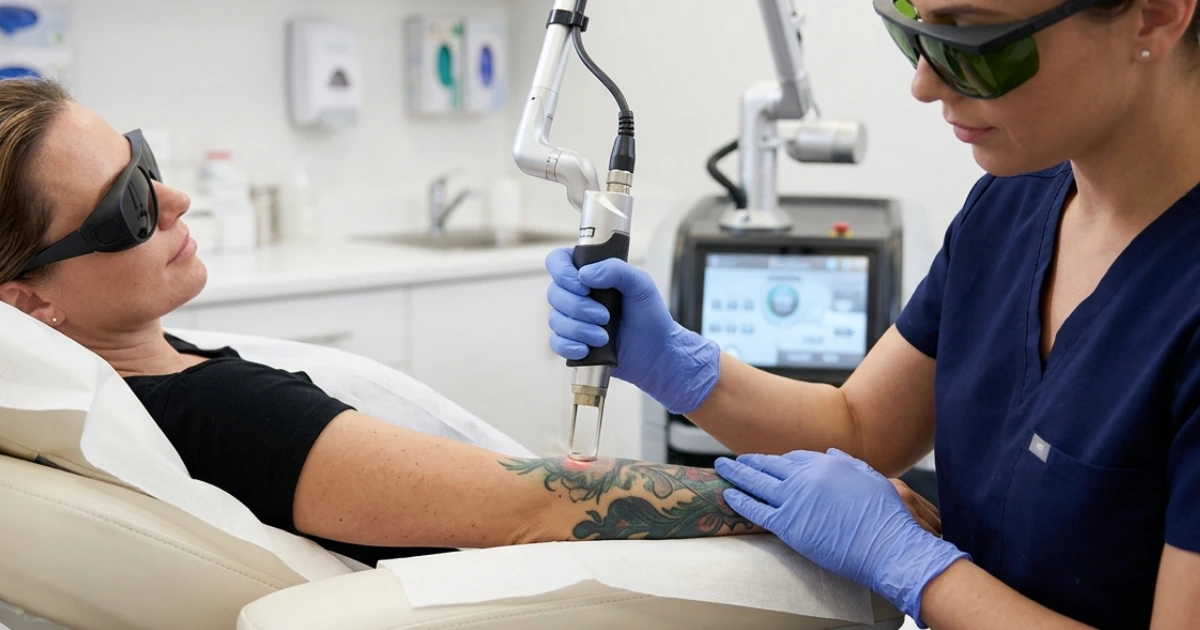
A tattoo removal laser delivers very short bursts of light that the pigment absorbs and converts into energy, shattering each particle into smaller fragments. Your lymphatic system then carries those fragments away over the following weeks, which is why tattoo fading happens in stages rather than all at once.
The entire process depends on one thing: the pigment has to absorb that specific light. When it does not, the particles stay intact, and the tattoo looks unchanged.
Why Ink Color Is the Biggest Variable
Color is the single largest reason two tattoos respond differently, and understanding how tattoo ink color affects removal clears up most of the confusion patients bring to a consultation. Different pigments absorb different wavelengths of light. A laser that works beautifully on one color may barely register on another.
Here is the general pattern providers see:
- Black and dark blue absorb the widest range of wavelengths, so they usually respond first and most predictably.
- Green and bright blue need specific wavelengths that older, single-wavelength devices didn’t produce.
- Yellow, orange, and light pastels reflect more light than they absorb, which makes them the most resistant colors of all.
- White and flesh-toned ink can sometimes darken after treatment, so a provider should assess it carefully before treating.
A colorful tattoo can still be treated. The plan just has to account for color.
Depth, Saturation, and Age: How Ink Responds
Two black tattoos can behave completely differently, and that usually comes down to physical variables rather than pigment chemistry. Heavily saturated, solid-fill work packs far more ink per square inch than fine-line work, so there is more material to break down. A dense blackout piece and a small script tattoo are different jobs.
How the tattoo was applied matters too. Amateur tattoos are often placed shallower and use less consistent ink, which makes their response harder to predict. Cover-ups stack layers of pigment, which means the laser has to work through more than one tattoo.
Age and placement matter as well. Older tattoos have already lost some pigment to years of natural immune activity, which generally works in your favor. Tattoos on the chest, back, and upper arms sit near strong circulation and tend to clear more readily than ink on the hands, ankles, or lower legs.
If you are unsure which category your tattoo falls into, contact our team and describe what you are working with.
What Advanced Laser Technology Does Differently
Modern systems improve on older devices in two ways, and both matter for stubborn tattoo ink. The first is wavelength range. Rather than treating every color with one setting, a provider can select the wavelength a specific pigment actually absorbs, which is what made green and blue ink practically treatable.
The second is pulse speed. Faster pulse durations, including the picosecond technology behind our Pico Laser service, shatter pigment using pressure rather than sustained heat. Finer fragments are easier for your body to clear, which is the mechanism behind most current approaches to stubborn tattoo ink treatment.
Skin type factors into the settings too, because melanin competes with tattoo pigment for the same laser energy. Providers use the Fitzpatrick skin type scale, a rating from I (very fair) to VI (very deep), to guide safe wavelength and energy choices. Settings are then adjusted per tattoo, per body area, and between tattoo removal sessions as the ink responds.
Common Questions About Stubborn Tattoo Ink
Does stubborn ink mean my tattoo cannot be removed?
Not usually. Resistant pigment typically means slower progress rather than no progress, though results vary and complete clearance is never something a provider can promise.
Why did one part of my tattoo fade faster than the rest?
Most tattoos contain more than one pigment, applied at slightly different depths and densities. Uneven fading is common and expected.
Can a tattoo partially treated elsewhere still be worked on?
In most cases, yes. Your provider will want to know what device was used and how your skin responded.
Is a consultation worth it if I already think my ink is difficult?
Yes, because an in-person assessment is the only reliable way to judge pigment depth and saturation.
Understanding Your Ink Is the First Real Step
Stubborn ink is not a mystery once you know what drives it. Color determines how much light a pigment absorbs, saturation and depth determine how much material has to break down, and age and placement affect how efficiently your body clears the fragments. Newer laser platforms address those variables with multiple wavelengths, faster pulses, and settings matched to your skin.
If you have been discouraged by a tattoo that has not budged, an assessment is a practical place to restart. Book Your Tattoo Removal Consultation at Evolution Aesthetics to talk through laser tattoo removal for stubborn ink in Freeland, MI could realistically look like for you.